How to Choose the Perfect Kitchen Sink
- News
- 07 Sep, 2017
Tips to Choose the Perfect Kitchen Sink
Learn about the various materials, different basin configurations, sink shape, and maybe some useful accessories and of course speciality sinks.
Have you head of the phrase, “everything but the kitchen sink” this is certainly fitting because ” the sink ” is quite difficult to take/move. If a family suddenly leaves with “everything but the kitchen sink,” it of course suggests that they made off with items that aren’t bolted down. Now, listen up! Here is a new slant for that term: What if that family didn’t take the storied sink because it is simply too important to the kitchen?
Come to think of it, there are only a few items within a family home that are in use and as important. Just think about what other home item is capable of taking on so many essential tasks? It’s also arguably one of the more important choices when it comes to building a new kitchen and/or remodelling. It is a decision not to be taken lightly because it will affect your daily routine for many happy years to come. We turned to the advice of some interior designers, and professional room planers to find out how to select the perfect kitchen sink.


What Configuration & How Many Basins?
- The Large Single Sink
Pros: The Single , deep basin Sink allows you to soak with ease, wash and prepare large quantities of food and wash those large roasters.
Cons: Multi-Tasking can certainly be easier! Imagine wanting to wash and prep some vegetables while there is something already soaking? You should also be reminded of the tricky process of washing and rinsing at the same time!
We found a Master Certified Kitchen and Bath Designer who explained that we’ve been seeing the typical kitchen sink become wider and deeper and with so many to choose from the it’s hard to not see it’s beauty.
That being said, most clients do opt for a deep, single basin sink that is between 33 to 36 inches wide and up to 10 inches deep. These sinks are very versatile!
The trickery of doing prep work and cleaning at the same time can be easily overcome with accessories. Almost all manufacturers offer a number of unique add-ons. Our pick is a rinse basket designed specifically for the sink of your choice.


2. 60/40 – Double Basin Kitchen Sink
Pros: Having 2 basins gives you the flexibility to perform separate tasks, which could be, cleaning cutlery/dishes and doing food preparation. A sink with a60/40 offset has one basin that is about 18 inches wide and the second that is 14 inches wide. The concept is for you to clean up in the larger basin and complete prepared food in the smaller. Having 2 basins is also handy when washing dishes, allowing for 1 sink to wash and the other to rinse.
Cons: Smaller basins are harder to effectively soak large items like pans.
If Flexibility is important this is certainly the choice for you… Most people who are used to this sink configuration also find it hard to make a switch.

3. The 50/50 – 2 Basin Sink
Pros: For those of you who love design symmetry – This is your sink! Allowing the benefit of separate tasks, like cleaning and rinsing!
Cons: Larger pans/items might have to be soaked on the counter!
Although some people are very used to this layout, when choosing a replacement they tend to decide on a configuration they feel better suits their needs.

4. The 3 Basin Sink
Pros: This configuration allows you to use the garbage disposal independently of the sink.
Cons: Some models, like this one, prevent you from sweeping food scraps from the counter and into the disposal – It’s a much wider sink, so more space is needed.


Choosing the Size of Your Sink
- Farmhouse
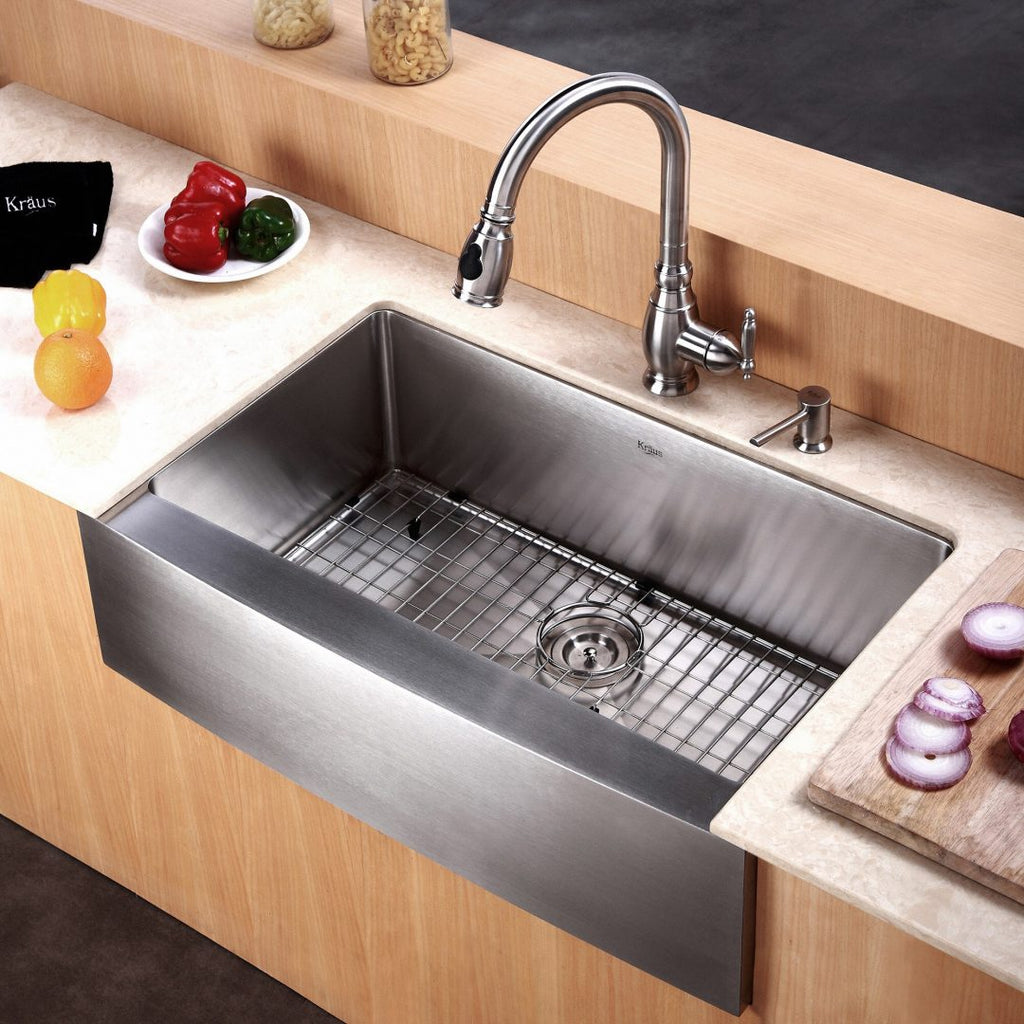
Pros: Most farmhouse sinks are single, large basins. The difference is their apron front, which has a cool vintage vibe that many people love. With a typical sink, the basin is around 4 inches away from the edge of the countertop, but these sinks tend to actually sit beyond the counter line. For those who are a shorter stature and kids, a farmhouse sink tends to be easier to use. Selecting porcelain or ceramic kitchen sinks, provide you with a wealth of colour choices.
Cons: The farmhouse sink makes a huge design statement that will be with you for a long time —Great… until your tastes change or you decide to sell and the potential buyers aren’t keen on the same bold design.
2. Double Farmhouse
Pros: Benefits are the same as all other double sinks.
Cons: Not the true vintage style of the single-basin farmhouse sink.

3. Rounded Sink
Pros: It has been considered that a curved sink easier to clean.
Cons: If sleek and the minimalist look is what you are after for your kitchen style, this may not be the look for you.
4. Sink with Drainboard
Pros: Great for draining dishes! If you like to do a lot of hand washing, it’s very convenient. The drainboard also gives a great space for fruits and vegetables to dry after washing.
Cons: The wider sink design loves to eat up countertop space.
Choosing Your Kitchen Sink Material

- Stainless Steel
Pros: Easy to Clean, durable design.
Cons: The metal can scratch, but the marks can be buffed out of brushed stainless steel. Most manufacturers offer bottom grids (wire trays that are placed in the bottom of the sink to prevent scratching). Also, if you live in a area with hard water, water spots can be a problem.


2. Porcelain
Pros: Traditional material that looks amazing in kitchens with a vintage style. This is the go-to for people who love colour, as the choices are endless.
Cons: Porcelain sinks can chip, leaving a black mark. Metal pans can also leave black marks or scuffs that are difficult to remove. A high level of care needs to be taken in order to have this sink looking beautiful for years to come.
3. Composit – Granite
Pros: Granite is made from particles and polymers, this material resists scratches and chips. It does not show water spots either.
Cons: Light-coloured granite kitchen sinks can sometimes stain, So keep in mind that some special maintenance is required.

4. Stone – Natural
Pros: A natural stone sink — soapstone being the most common choice — can exactly match your countertop material and can give a kitchen an authentic period look.
Cons: The material is costly, and it can scratch and chip. Special cleaning products may be required.
Sink Accessories
Pros: Sink manufacturers are making the sink work harder with myriad accessories built to perfectly fit on the lip of the basin. The choices include cutting boards, prep bowls, knife blocks, colanders and racks for dishcloths or cleaning utensils. These items can centralize and organize prep work.
Cons: To achieve a perfect fit, it’s best to buy directly from the manufacturer. If you subscribe to the “basic is better” school of thought, sink accessories are not for you.
Accessories are usually designed to be removed for cleaning and when not in use, where to store them has to be considered. He also notes that if a sink manufacturer doesn’t make the accessory you want, a designer can have it custom made.
Specialized Sinks
- Sink Systems
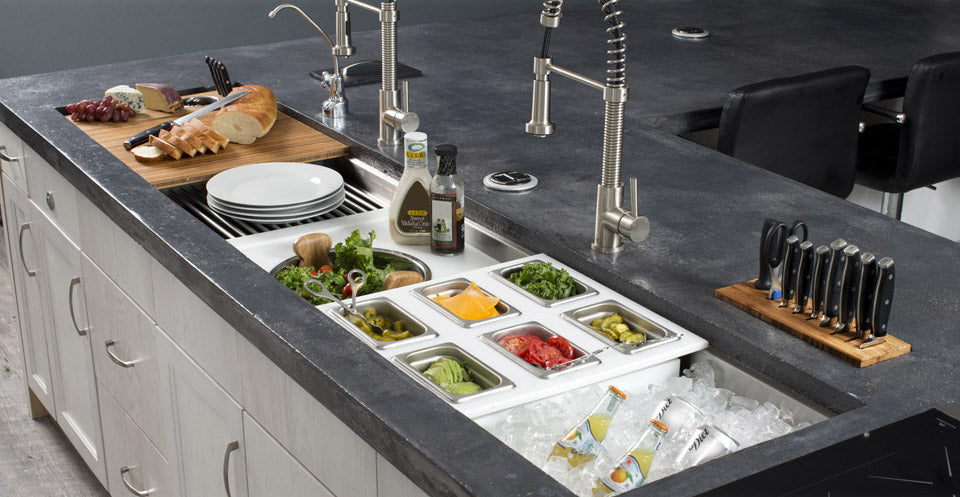
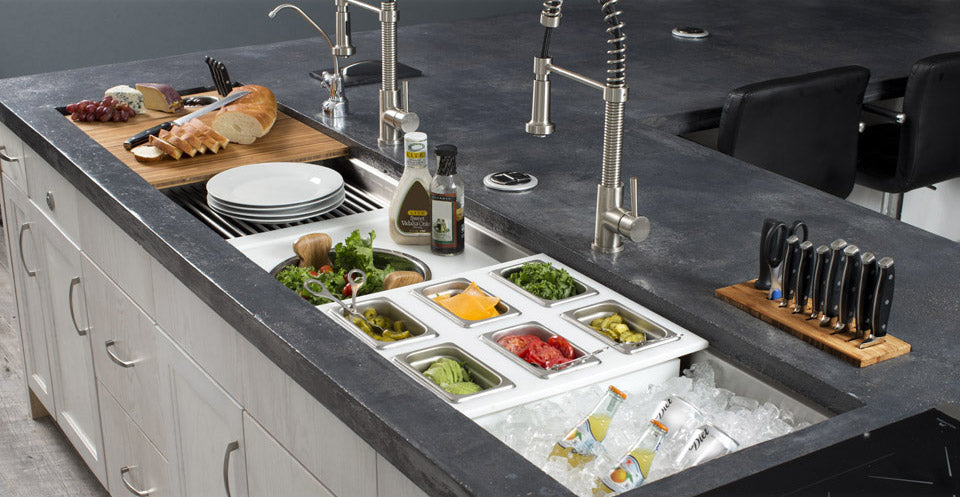
Pros: More manufacturers are making very specialized sink systems, such as the galley sink. In units such as this one, everything from rinsing to chopping to serving (made possible by ice chest and condiment container inserts) happens at the sink.
Cons: This sink can take up a lot of countertop space, although the prep areas it provides may make up for that.
Because it’s so involved, this option is not for the casual cook. The industrial look makes a strong statement.
2. Lowered Divided Sink
Pros: Want to have a double sink and be able to comfortably wash or soak a long-handled pan? A sink with a lowered divider might be for you.
Cons: If your cooking style demands deep water, this is not an ideal configuration.